A Healing Meditation Practice
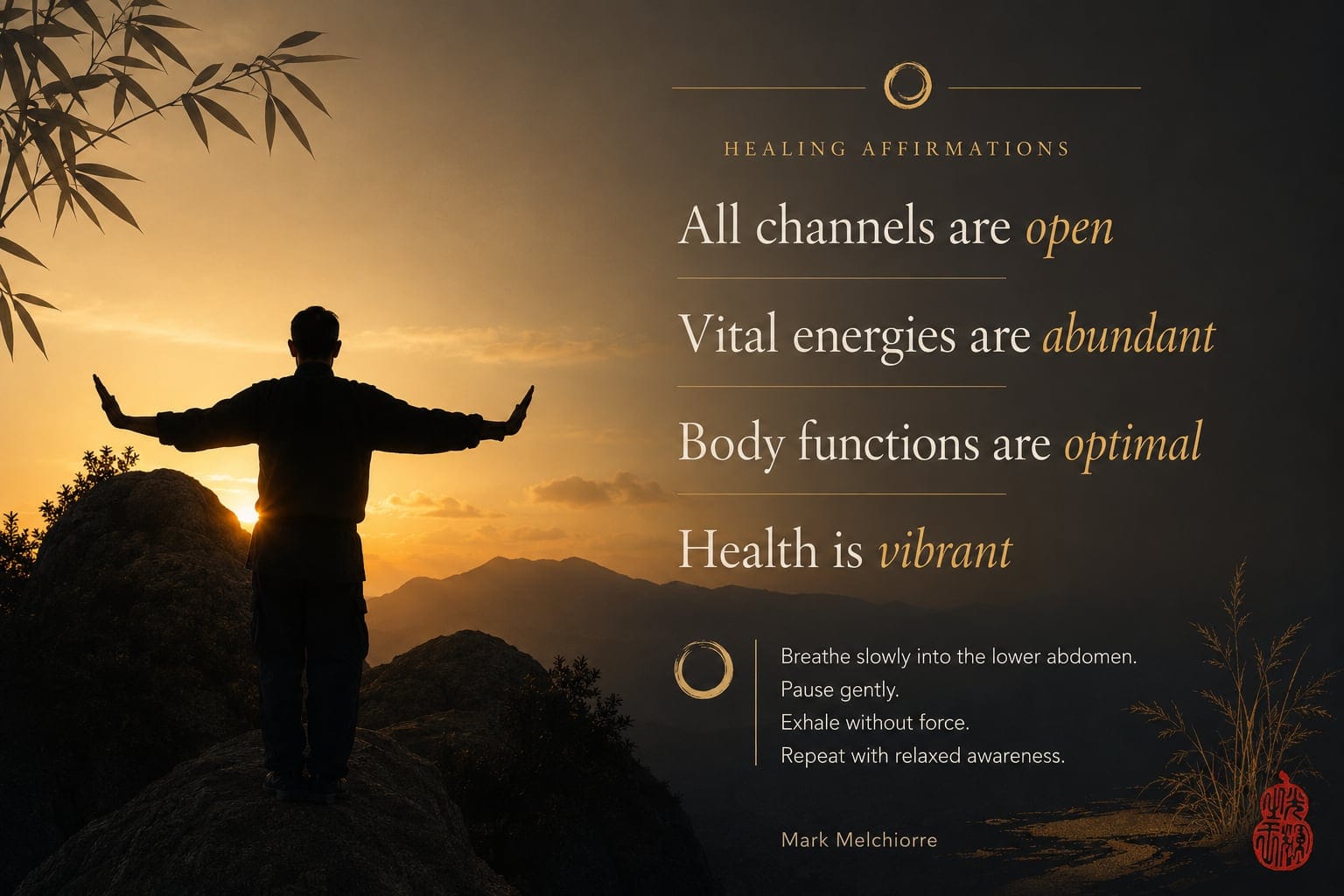
Healing affirmations are not magical thinking.
They are intentional patterns of attention that help guide breath, awareness, emotional state, and physiology toward balance.
In qigong practice, spoken intention works together with posture, movement, and breath to cultivate coherence between body and mind.
Why Affirmations Matter
Affirmations influence the direction of attention.
Modern neuroscience shows that repeated thought patterns can strengthen emotional and behavioral pathways in the brain through a process known as neuroplasticity. When combined with relaxed breathing, mindful awareness, and embodied movement, affirmations may help reduce stress reactivity and reinforce healthier mental and emotional states.
In Taoist cultivation traditions, intention — often described as yi — is considered an essential component of energetic practice. Where awareness goes, energy follows.
Healing affirmations are most effective when they are:
- calm rather than forceful
- believable rather than exaggerated
- practiced consistently
- paired with breath and embodied awareness
The goal is not to deny difficulty or suppress emotion.
The goal is to gently orient the nervous system toward resilience, openness, and healing.
Research & Scientific Perspective
While affirmations are not a substitute for medical care, psychological research suggests that positive self-directed statements can influence stress regulation, emotional resilience, and self-perception.
Research in self-affirmation theory has shown potential benefits including:
- reduced stress responses
- improved emotional regulation
- greater psychological flexibility
- improved receptivity to positive behavior change
Breath-centered practices that include focused attention and repeated phrases have also been associated with:
- reduced sympathetic nervous system activation
- improved vagal tone
- lower perceived stress
- enhanced mindfulness and emotional regulation
In qigong and meditation traditions, affirmations are often practiced not as intellectual statements alone, but as embodied experiences integrated with breathing, posture, and relaxation.
A Simple Practice
All channels are open
Vital energies are abundant
Body functions are optimal
Health is vibrant
- Sit or stand comfortably
- Relax the jaw, shoulders, and abdomen
- Breathe slowly through the nose
- Repeat the affirmation gently — aloud or silently
- Allow the words to be felt physically, not merely recited mentally
- Continue for 3–10 minutes
You may also synchronize the affirmation with movement during qigong practice.
Selected Research & Reading
- Norman Doidge — The Brain That Changes Itself — Accessible introduction to neuroplasticity and repeated mental patterns by Norman Doidge.
- Claude Steele — The Psychology of Self-Affirmation — Foundational paper introducing self-affirmation theory.
- Carnegie Mellon — Benefits of Self-Affirmation — Overview of research showing self-affirmation may buffer stress and improve performance under pressure.
- Self-Affirmation Improves Problem-Solving Under Stress (PLOS ONE) — Peer-reviewed Carnegie Mellon study on self-affirmation and chronic stress.
- NIH / PMC — Effect of Meditation on Autonomic Function — Research examining meditation and autonomic nervous system regulation.
- NIH / PMC — Meditation Programs for Psychological Stress and Well-Being — Large review of meditation research and stress reduction outcomes.
- Herbert Benson — The Relaxation Response — Classic work on meditative repetition, breath, and physiological relaxation by Herbert Benson.
Healing begins not only with what we do, but with the quality of awareness we bring to each breath, thought, and movement.
Continue Exploring
Explore additional practices and resources that support balance, mindfulness, and daily well-being.
Nine Phases Qigong
A qigong practice that guides you step-by-step—from first sensing qi in the body to refining and integrating it at deeper levels of mind and spirit.
Breath Medicine
An introduction to the transformative role of breath in cultivating relaxation, awareness, resilience, and energetic harmony.
Yin-Yang Balancing Qigong
A calming practice that harmonizes opposing energies within the body while encouraging grounding, fluidity, and centered awareness.
Continue Exploring
Explore additional practices and resources for balance, mindfulness, and daily well-being.
Nine Phases Qigong
A step-by-step qigong practice for sensing, refining, and integrating qi.
Breath Medicine
Explore how breath supports relaxation, awareness, and resilience.
Yin-Yang Balancing Qigong
A calming practice that cultivates grounding, fluidity, and inner balance.
Practices
Explore practices for balance, awareness, and daily well-being.
Recommended Resources
Books, videos, and learning materials for further study and inspiration.