A flowing qigong practice designed to harmonize Yin and Yang through mindful movement, breath awareness, and focused intention. This sequence combines gentle stretching, energy circulation, and meditative imagery to help restore balance throughout the body and calm the nervous system.
A Moving Meditation for Balance and Vitality
Yin-Yang Balancing Qigong blends soft flowing movements with deep breathing and relaxed awareness. Each posture is practiced slowly and mindfully, allowing the body to release tension while encouraging the smooth circulation of Qi (life-force energy).
The practice emphasizes the synchronizing body, breath, and mental intent.
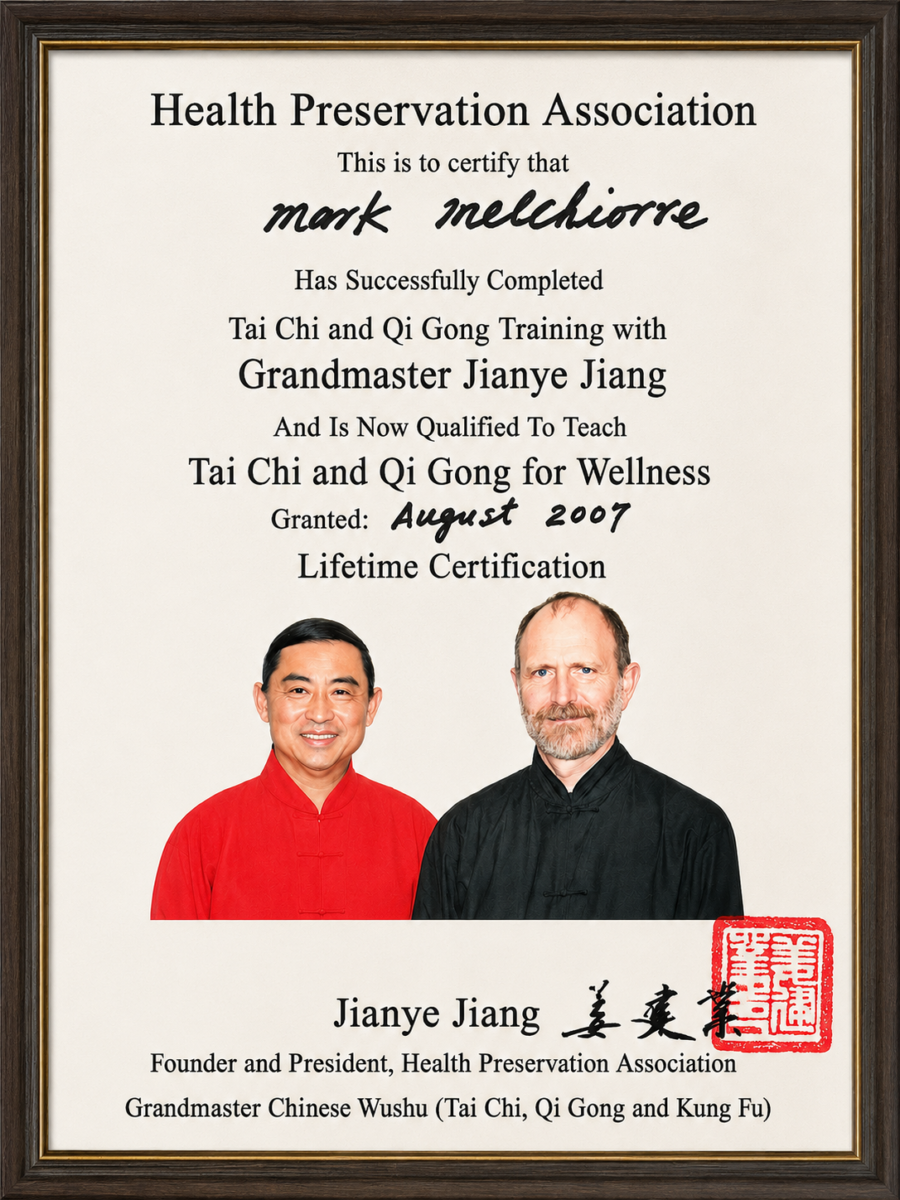
This Yin-Yang Balancing Qigong practice is inspired by Jiang Jian-ye, my teacher, and his Yin Yang Medical Qigong form.
Grand Master (Shifu) Jiang Jian-ye is a highly respected teacher of traditional Chinese martial arts and internal cultivation practices, known for his lifelong dedication to authentic Tai Chi, Kung Fu, and qigong instruction.
The flowing movements and energetic principles reflected in this practice are offered with gratitude and respect for that tradition and lineage.
Benefits of Yin-Yang Balancing Qigong
Regular practice may help support:
- Relaxation and stress reduction
- Improved balance and coordination
- Greater body awareness and flexibility
- Healthy circulation and energy flow
- Calm breathing and nervous system regulation
- Mental clarity and emotional steadiness
- Gentle strengthening without strain
- A deeper sense of grounding and centeredness
This practice is accessible to beginners while still offering depth for experienced practitioners.
The Flow of the Practice
The sequence moves through a series of flowing forms inspired by nature, animals, and traditional qigong imagery. Each movement encourages the body to open, soften, and circulate energy in a different way.
Aligning the Three Treasures
The practice begins by aligning the Three Treasures — body, breath, and mind — creating a stable foundation for balanced movement and energy flow.
- Body — posture lengthened, muscles relaxed, joints softened
- Breath — smooth, natural, and synchronized with movement
- Mind — calm, clear, and gently focused
As the body settles and the breath deepens, awareness becomes more centered and the practice begins to flow naturally.
1 — Peng Bird Flying Through the Air
Arms rise like the wings of the mythical Peng bird, expanding with the inhale and softening with the exhale. The movement encourages length through the spine while grounding through the legs.
2 — Lotus Flower Emerging from the Water
Like a lotus opening and closing with the rhythm of the breath, the arms unfold outward and return inward. This movement cultivates softness in the shoulders, chest, and upper back while reinforcing the connection between breath and motion.
3 — Goldfish Wiggles Its Tail
A playful flowing movement that loosens the shoulders and upper body while encouraging relaxed breathing and fluidity.
4 — Ripples and Waves
Gentle pushing movements create the sensation of water moving outward in waves. The body sinks and rises naturally with the breath, encouraging groundedness and smooth energy circulation.
5 — Lion Playing with the Chi Ball
The practitioner imagines holding a sphere of energy between the palms, gathering and guiding qi through the torso and into the dantian energy centers.
Attention is brought to:
- Heart and lungs
- Digestive organs
- Kidneys and lower body vitality
This section emphasizes internal awareness and energetic nourishment.
6 — Peacock Spreading Its Tail Feathers
With expansive circular movements, the arms rise and open like a peacock displaying its tail feathers. Palms face outward as the hands sweep overhead, gathering qi and guiding it down through the body’s centerline into the lower dantian.
The movement then repeats — once more “spreading the tail feathers.” During this second gathering, the practitioner pauses with the palms facing the crown of the head and visualizes qi entering through the Baihui point at the top of the head, permeating the entire body with calm, nourishing energy. This expanded posture encourages a feeling of openness, vertical alignment, and energetic connection from the crown through the center core and into the lower dantian.
Attention then moves through the sensory organs and internal systems of the body:
- Palms descend to eye level to support vision, hearing, and sensory awareness
- Hands move toward the nose and mouth area to support respiration and digestion
- Palms align with the chest to energize the heart and lungs
- Awareness lowers to the midsection to nourish the spleen, pancreas, stomach, liver, gallbladder, and intestines
- Finally, attention settles at the lower dantian to support the kidneys, bladder, and lower energetic center
The movement combines breath, visualization, and flowing motion to cultivate a sense of vitality and whole-body integration.
7 — Swallows Skimming the Water
Side-to-side weight shifting introduces gentle rotation through the waist and fascia. The flowing transitions help cultivate coordination, balance, and smooth whole-body movement.
8 — Wind Through the Willow Branches
Soft circular arm patterns encourage relaxed shoulders and flowing movement through the upper body while maintaining grounded footwork and stable posture.
9 — Waterfall Energy Practice
The body sinks and rises with the imagery of cascading water, guiding awareness toward the low back, kidneys, and spine. This movement combines grounding energy with gentle spinal activation.
10 — Wind Swirling Over the Giant Lotus Leaf
Circular spiraling movements gather and direct qi toward the lower dantian, helping cultivate centeredness and energetic stability.
11 — Embracing Yin and Yang
The practice concludes with balancing gestures symbolizing harmony between opposing yet complementary energies — expansion and contraction, rising and sinking, activity and stillness.
The movements become quieter and more meditative as awareness settles inward.
12 — Butterflies Floating in the Breeze
The hands drift lightly through the air like colorful butterflies carried by a gentle breeze. The movement is soft, playful, and relaxed, encouraging openness through the shoulders and a sense of ease throughout the body.
This flowing transition helps quiet the mind while maintaining awareness of the subtle sensations of qi moving around and through the body.
13 — Polishing the Pearl
The hands return to the centerline, one palm above the other, spiraling gently around an imagined sphere of energy between the palms. Practitioners visualize a smooth radiant pearl of qi forming at the center of the hands.
As the hands rotate and change positions, awareness settles into the sensation of gathering, refining, and condensing energy. The pearl becomes dense, balanced, and luminous — symbolic of cultivated inner vitality.
The movement concludes by guiding that refined qi inward, allowing the energy to settle naturally into the body’s center.
14 — Energizing the Dantians
As the practice becomes quieter and more internal, qi is gathered and guided into the body’s primary energy centers. The arms circle overhead with the inhale, collecting energy from Heaven and Earth before pausing with the palms facing the crown of the head.
With the exhale, practitioners visualize qi entering through the Baihui point at the top of the head and flowing down through the body’s centerline.
Attention is then brought progressively to the three dantian:
- Upper Dantian — palms align near the third-eye area, cultivating clarity, awareness, and calm presence
- Middle Dantian — palms move to mid-chest level, supporting breath, emotional balance, and heart energy
- Lower Dantian — hands lower toward the abdomen, grounding and storing qi within the body’s energetic center
Each breath gently “charges” the dantian, allowing energy to settle deeply within. After the final exhale, the breath returns to a completely natural rhythm as the body rests in quiet awareness.
We Close with Standing in Stillness
The practice concludes in a quiet standing posture similar to Zhan Zhuang, allowing the movements and breath-work to settle into stillness.
Breathing becomes completely natural as awareness turns inward. Practitioners gently scan the body, relaxing unnecessary tension while maintaining balanced alignment:
- Weight evenly distributed between both feet
- Shoulders soft and relaxed
- Joints open without strain
- Spine naturally lengthened
- Tongue lightly resting on the roof of the mouth behind the front teeth
The posture is calm yet alive — relaxed without collapsing, grounded without rigidity. In this stillness, Qi is allowed to circulate freely throughout the body, flowing naturally where it is needed most.
This is a slow and mindful practice rather than a strenuous workout.
Movements are:
- Gentle and low impact
- Coordinated with natural breathing
- Accessible for many fitness levels
- Performed standing with soft knees and relaxed joints
Practitioners often report feeling calmer, more grounded, energized, and mentally clear after practice.
Begin Your Practice
Yin-Yang Balancing Qigong is both calming and revitalizing — a gentle moving meditation that helps restore harmony throughout body, breath, and mind.
Whether you are new to qigong or deepening an existing practice, this sequence offers a peaceful way to cultivate balance, awareness, and vitality through mindful movement.
Continue Exploring
Explore additional practices and resources that support balance, mindfulness, and daily well-being.
Tai Chi Easy™
Gentle mindful movement designed to support relaxation, balance, and overall well-being.
Learn More →Breath Medicine
An introduction to the transformative role of breath in cultivating relaxation, awareness, resilience, and energetic harmony.
Learn More →Seven-Cycle Body Awakening
A gentle practice designed to awaken the body’s natural energy systems and cultivate a greater sense of vitality and inner connection.
Learn More →Continue Exploring
Explore additional practices and resources for balance, mindfulness, and daily well-being.
Tai Chi Easy™
Explore gentle mindful movement for relaxation, balance, and well-being.
Breath Medicine
Explore how breath supports relaxation, awareness, and resilience.
Seven-Cycle Body Awakening
A gentle practice for awakening the body’s natural energy systems and cultivating vitality.
Practices
Explore practices for balance, awareness, and daily well-being.
Recommended Resources
Books, videos, and learning materials for further study and inspiration.