Earth below us. Sky above us. Breath moving through us.
A gentle moving meditation that combines breath, posture, awareness, and flowing movement to cultivate balance, mobility, and calm presence.
What is the Eight Pieces of Brocade?
The Eight Pieces of Brocade — traditionally known as Baduanjin — is one of the oldest and most widely practiced qigong systems.
Its origins are often traced back nearly a thousand years, where the movements were practiced to cultivate vitality, coordination, posture, and internal balance.
Unlike martial arts forms focused on combat, the Eight Brocades developed as a simple and accessible practice that could be integrated into daily life.
Today, people around the world continue practicing these movements as a form of mindful exercise, moving meditation, and energetic cultivation.
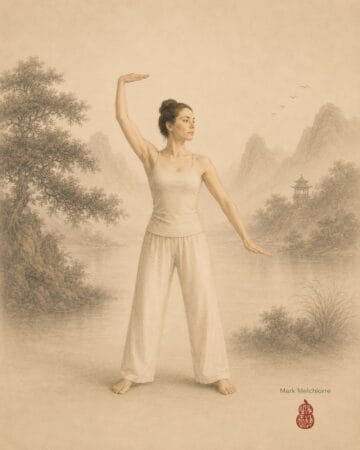
Breathe Deeply
Allow the breath to deepen naturally.
Relax the Body
Drop the shoulders and soften the knees.
Tune Inward
Feel what the body is experiencing.
Move as One
Coordinate breath, posture, and movement.
The Eight Pieces of Brocade
1- Two Hands Hold Up the Heavens
A gentle upward stretch that lengthens the spine, expands breathing, and awakens the body from head to toe.
Energize the Body:
Lengthen upward while staying relaxed through the shoulders and abdomen.
2 — Draw the Bow
A grounded side-to-side movement that develops coordination, balance, and focused intention.
Strengthens Lower Body:
Move slowly and evenly, allowing breath and posture to synchronize.
3 — Separate Heaven and Earth
An opening movement that encourages postural alignment while gently engaging the core and breath.
Benefits Digestive System:
Lift through the crown of the head while softening downward through the hips.
4 — Wise Owl Gazes Backward
A gentle twisting movement that opens the chest and encourages mobility through the neck and upper body.
Benefits the Neck:
Move slowly and avoid straining the neck.
5 — Sway the Head and Shake the Tail
A grounding movement that mobilizes the hips, spine, and torso while encouraging relaxed breathing.
Lubricates Joints:
Shift weight smoothly and keep the torso long.
6 — Two Hands Hold the Feet
A forward folding movement that lengthens the back body and creates space through the spine.
Benefits Kidneys and Waist:
Reach upward before folding slowly downward.
7 — Clench the Fists with Fierce Gaze
A stronger, more energizing movement that develops focus, rootedness, and coordinated strength.
Power and Vitality:
Move with intention while keeping unnecessary tension out of the shoulders.
8 — Rise on the Toes, Drop on Heels
A gentle bouncing movement that encourages circulation, grounding, and full-body relaxation.
Grounding:
Stay loose and relaxed through the joints.
Practice at your own pace. Move slowly, breathe naturally, and allow awareness to settle into the body.
Practice Guidelines:
- Relax the shoulders
- Breathe comfortably
- Move within your range
- Pause anytime
- Consistency matters more than intensity
People often return to the Eight Pieces of Brocade because the practice is both calming and energizing at the same time.
With regular practice, many notice:
- improved body awareness
- smoother breathing
- better mobility
- a greater sense of calm and grounding
- a simple daily rhythm of mindful movement
The Eight Brocades can be practiced almost anywhere and adapted for many experience levels.
Frequently Asked Questions
Is Eight Pieces of Brocade good for beginners?
Yes. The Eight Pieces of Brocade is often recommended for beginners because the movements are slow, repetitive, and easy to adapt to different experience levels.
The practice emphasizes awareness, posture, breathing, and coordination rather than athletic performance or flexibility. Many people begin with just a few minutes at a time and gradually become more comfortable with the sequence.
The goal is not perfection, but relaxed and mindful movement.
Is Eight Pieces of Brocade tai chi or qigong?
The Eight Pieces of Brocade is a form of qigong.
Qigong is a broad category of practices that combine movement, breathing, posture, and awareness to cultivate balance and vitality.
Tai chi includes many qigong principles, but is generally practiced as a longer flowing martial art form. The Eight Brocades is typically simpler and easier for beginners to learn while still offering many of the same benefits associated with mindful movement and breath awareness.
How often should I practice?
Consistency matters more than duration.
Even a short daily practice can help develop familiarity with the movements, breathing, and relaxed attention. Many people find that practicing for 10–20 minutes several times a week creates a noticeable sense of rhythm and grounding.
Some enjoy practicing in the morning to awaken the body, while others use it later in the day to unwind and settle the mind.
How long does the practice take?
A complete Eight Pieces of Brocade routine is often practiced in about 10–20 minutes, depending on pacing and repetition.
Some practitioners move slowly and meditatively, while others practice a shorter version as part of a broader tai chi or qigong routine.
There is no single “correct” speed. Slow, relaxed, and attentive movement is generally more important than rushing through the sequence.
Do I need special breathing techniques?
No special breathing method is required to begin.
In most cases, natural relaxed breathing is the best place to start. As the body settles and the movements become more familiar, breathing often begins to synchronize with the practice naturally.
Rather than forcing the breath, focus on allowing it to deepen gradually while keeping the shoulders, abdomen, and jaw relaxed.
Can older adults practice the Eight Brocades?
Many older adults enjoy the Eight Pieces of Brocade because the movements are generally low-impact and adaptable.
The practice can often be modified to accommodate mobility limitations, balance concerns, or reduced flexibility. Movements may be made smaller, slower, or performed from a seated position when appropriate.
As with any exercise program, individuals with medical concerns should consult a qualified healthcare professional before beginning a new physical practice.
What are the benefits of the Eight Pieces of Brocade?
People are often drawn to the practice because it combines gentle movement with mindful attention and breathing.
With regular practice, many people report experiencing:
- improved body awareness
- smoother breathing
- greater mobility and coordination
- better posture
- a calming effect on the nervous system
- a stronger sense of grounding and presence
Experiences vary from person to person, and the practice is best approached as a long-term cultivation rather than a quick fix.
Do I need to memorize all eight movements?
Not at all.
Many people begin by learning one movement at a time or simply following along with a guided video. Over time, the sequence often becomes more natural through repetition and relaxed practice.
The emphasis is less on memorization and more on developing awareness, coordination, and ease within the movements.
What should I focus on while practicing?
A simple place to begin is:
- relaxed posture
- comfortable breathing
- smooth movement
- gentle awareness
Rather than trying to “perform” the movements perfectly, allow attention to settle into the experience of moving and breathing.
You may notice sensations of balance, grounding, lengthening, relaxation, or increased circulation as the body begins to soften and coordinate more naturally.
Can I practice the Eight Brocades every day?
Yes. Many practitioners incorporate the Eight Pieces of Brocade into a daily routine because the movements are gentle and restorative.
Daily practice does not need to be long or intense. Even a few mindful minutes can become a valuable way to reconnect with breath, posture, and presence throughout the day.
Continue Exploring
Explore additional practices and resources that support balance, mindfulness, and daily well-being.
Nine Phases Qigong
A qigong practice that guides you step-by-step—from first sensing qi in the body to refining and integrating it at deeper levels of mind and spirit.
Breath Medicine
An introduction to the transformative role of breath in cultivating relaxation, awareness, resilience, and energetic harmony.
Yin-Yang Balancing Qigong
A calming practice that harmonizes opposing energies within the body while encouraging grounding, fluidity, and centered awareness.
Continue Exploring
Explore additional practices and resources for balance, mindfulness, and daily well-being.
Nine Phases Qigong
A step-by-step qigong practice for sensing, refining, and integrating qi.
Breath Medicine
Explore how breath supports relaxation, awareness, and resilience.
Yin-Yang Balancing Qigong
A calming practice that cultivates grounding, fluidity, and inner balance.
Practices
Explore practices for balance, awareness, and daily well-being.
Recommended Resources
Books, videos, and learning materials for further study and inspiration.